tcpTunnel
Front - TNL5
8.2 Front
Allows one set out the points marking the tunnel cross-section's excavation front.
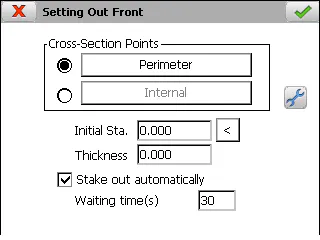
The user can select points on the theoretical cross-section (Perimeter), or inside it (Internal). In the first case, there are several methods (see Features and Functionality > Theoretical Points of the Tunnel Template).
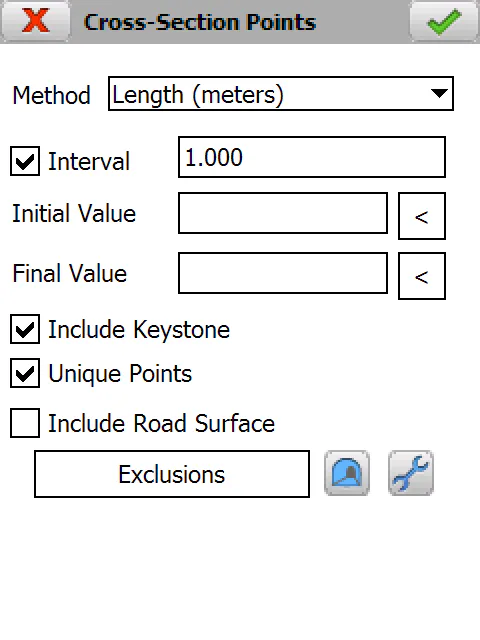
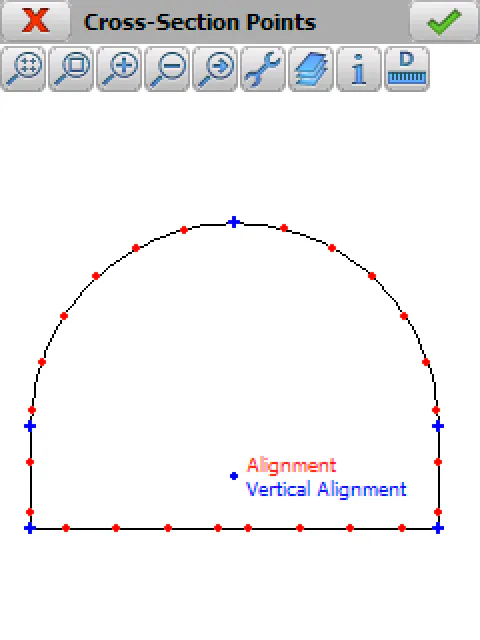
On the other hand, the program allows one to define theoretical points by entering a horizontal and vertical offsets regard to horizontal and vertical alignment application points. These points can be entered manually or import them from file. Each line in the file must have the format: number h_offset v_offset. A space must be entered between fields.
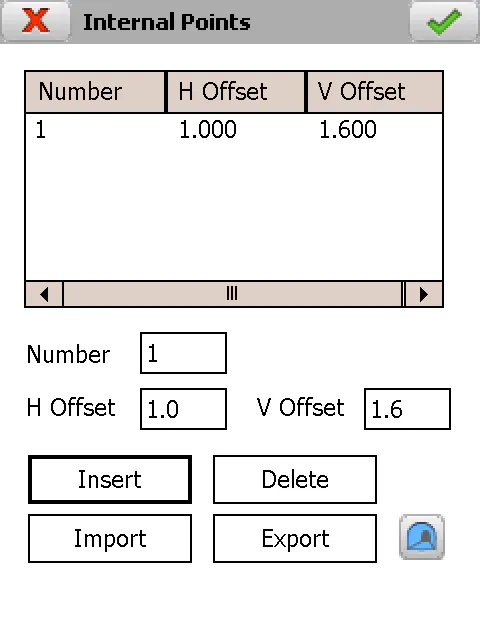
In both cases following input data is requested:
Initial Station. Approximate station of the excavation front. The tunnel template will be created in this station for comparing with measured points.
Thickness: It allows to create parallel tunnel templates. If a positive value is entered, the program will create a tunnel template with a bigger radius and, otherwise, a smaller tunnel template will be created.
If you want to stake out in continuous mode, the check box Stake out automatically must be enabled. In this case, a Waiting time, in seconds, must be entered for stopping the process after each point is staked out.
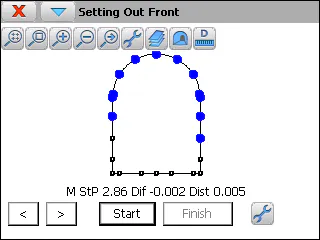
Once theoretical data is entered, clicking on accept button, the program shows the graphic screen for setting out.
The buttons 
 allow one to select the point to be set out. Clicking on Start button for starting the set out.
For each measurement, the program shows the measured station of the profile (M StP), the difference regard with the theoretical tunnel template, and 3D distance between theoretical and measured point.
After finishing the setting out of the point, it will be drawn in blue color if it meets the tolerances and it has been stored in result file, otherwise it will be drawn in red.
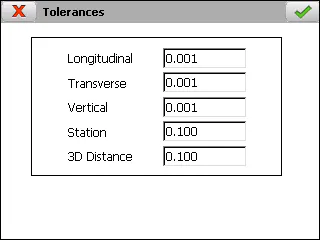
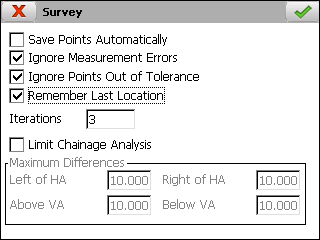
Before starting the setting out, several parameters can be modified within the setting option, such as 3D Distance and the number of Iterations.