
tcpMDT
Calculation methods - MDT25
26.3 Calculation Methods
Least Squares
This method consists of using several observation equations on the observations data and subsequently adjusting the result with the least squares method of the result. See the Least Squares section for more detailed information.
Each observation between traverse stations can generate several equations, depending on their data. If planimetric adjustment has been selected, a distance equation (as long as it is not null) and an azimuth equation (as long as the horizontal angle is not null) are created. If height adjustment is used, a vertical equation or slope equation is created (as long as the distance and vertical angle are not null). Lastly, an angle equation is created for all intermediate stations that helps to enhance the system's accuracy.
Each equation involves coefficients that depend on the specific observation values. These are assigned to the system coefficient matrix. Likewise, each equation has an independent term, which depends on the residual or the difference between the observed and calculated values. These values are stored in an independent term vector.
Additionally, in order to consider the effect of each observation on the system, a weighting matrix is created. Each observation has a weighting factor that depends on each observation's standard deviation, or the a priori error. These in turn depend on the characteristics of the equipment used, as set in the configuration.
The matrix equation is:

where:
X =Coordinate increments vector
A = Coefficient matrix
P = Weighting matrix
K = Independent term matrix
Once these matrices have been built, the calculation process for each increment in mobile station coordinates can begin. This ends when the system converges and the coordinates become definitive.
It is important to set the configuration values for the convergence and the maximum number of iterations correctly. Consult the Customization Manual for further details.
Proportional to Distance
If this method is chosen, the program calculates the total length of the traverse by adding up all the observation distances between the stations involved. In addition, it determines the closing error from the distance between the last station's theoretical position and its actual position.
The adjustment consists of modifying the intermediate mobile station observations proportional to the run length with regard to total traverse length.
The general formula is:
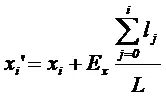
where:
x~i~ = Original coordinates of station i (the first is 0)
x~i~\' = Corrected coordinates of station i
E~x~ = Overall traverse error in X
~lj~ = Length of side j
L = Total length of the Traverse
The same formula is applied for Y and Z.
Proportional to Coordinate Increments
This method also uses total traverse length and the closing error, but the modification made to mobile station coordinates is proportional to the X, Y and Z errors found at each station with regard to total traverse error.
The general formula is:
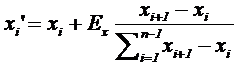
where:
x~i~ = Original coordinates of station i (the first is 0)
x~i~\' = Corrected coordinates of station i
E~x~ = Overall traverse error in X
The same formula is applied for Y and Z.
Rotation and Homothety
This method consists of performing a Helmert transformation on the traverse's initial and final points and applying this transformation to each of the intermediate points.
The formulas applied are:


where:
x~i,~ y~i~ = Original coordinates of station i (the first is 0)
x~i~\' y~i~\' = Corrected coordinates of station i
a,b,c,d = Transformation parameters
The stations' Z coordinates are not affected. As can be deduced, this method can only be applied to open traverses.
Crandall's Law
This method is used when angle measurements are more accurate than distance measurements. The entire angle error is distributed along the traverse and distances are recalculated, so that the sum of their modification's squares is the least possible.